Introduction
Imagine this: it’s 2 AM, you’ve got a severe fever that won’t break, and you’re scared. You do what feels like the responsible thing — you get in a taxi and go straight to the nearest hospital Emergency Room. The doctors treat you, you feel better, you go home relieved. Then, a week later, an invoice arrives in your inbox: AED 2,000, and it says your claim was rejected.

Here’s the hard truth almost nobody explains clearly when you sign up for a health card: Dubai basic health insurance does NOT cover direct hospital access unless your condition is a true, life-threatening emergency. Your “Basic” or Essential Benefits Plan (EBP) policy was never designed to let you walk into any ER for any reason. It was designed around a strict, DHA-aligned pathway — and if you skip that pathway, you can end up paying the full bill yourself, out of your own pocket, at the worst possible moment.
I’ve spent 12 years reviewing claims in this market, and I want to be direct with you: this isn’t a rare edge case. It’s one of the most common — and most expensive — mistakes I see Dubai residents make. So by the end of this article, you’ll know the exact 3-step process to get treated properly, protect your health, and keep your money in your pocket instead of handing it to a hospital cashier.
Why “Emergency” Means Something Different to Dubai Insurers (The DHA Definition)
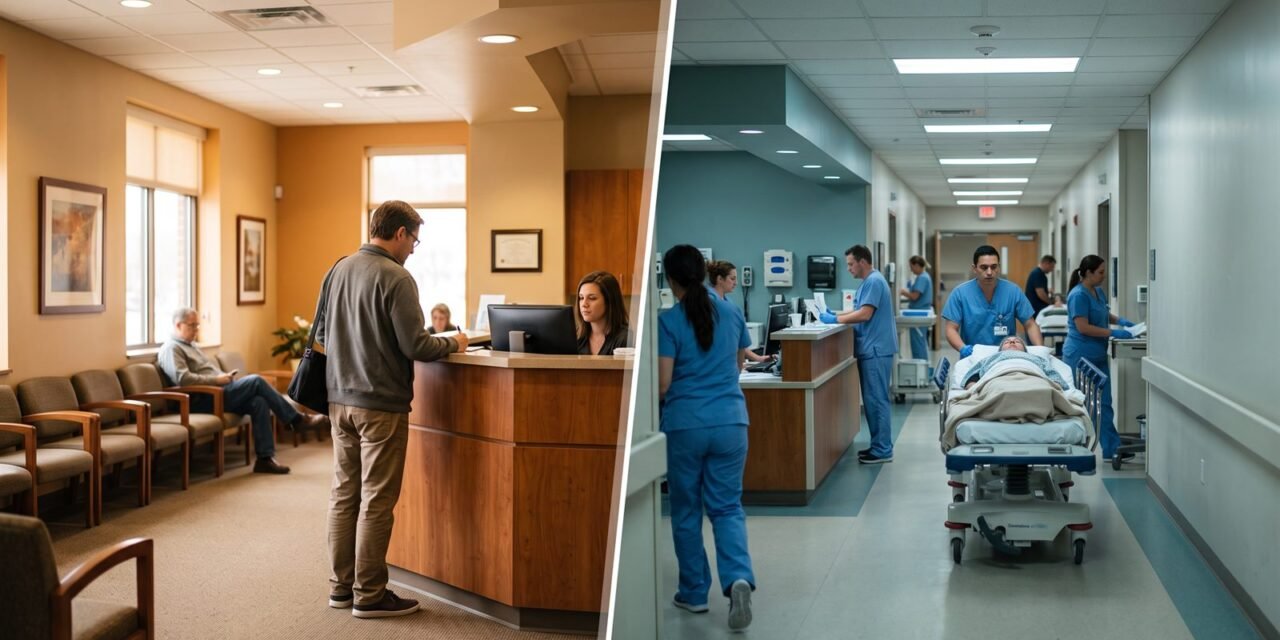
This is the part that catches people off guard: “emergency” in everyday language and “Emergency” under Dubai Health Authority (DHA) rules are two very different things. To you, an emergency might mean “this is bad enough that I need a doctor right now.” To your insurer, “Emergency” is a narrow, clinical category — a condition serious enough that any delay could risk your life, a limb, or a major organ function. Basic/EBP plans are built on a gatekeeper model: routine and non-critical care is meant to flow through a network clinic first, and only genuinely life-threatening conditions get direct, unrestricted hospital access. Everything else is expected to follow the referral pathway below — and if it doesn’t, the insurer is within its rights to deny the claim entirely.
What IS covered as an Emergency (Life-Threatening)
- Acute heart attack or severe chest pain suggesting cardiac arrest
- Stroke (sudden numbness, slurred speech, facial drooping, loss of balance)
- Major trauma from a road traffic accident or serious fall
- Sudden loss of consciousness or seizures
- Severe, uncontrolled bleeding
- Severe anaphylactic (allergic) shock, or difficulty breathing/choking
- Suspected poisoning or overdose
What is NOT covered (Urgent but NOT Emergency)
- Migraines or bad headaches
- A high fever without convulsions
- Sprains, minor fractures, or soft-tissue injuries
- Earaches, sore throats, or sinus pain
- Stomach aches, mild food poisoning, or nausea
- Skin rashes or minor cuts
- Common flu or viral infections
Warning: If you walk into an ER with a sprained ankle or a bad flu and describe it as an “emergency,” the hospital will treat you — but your Basic policy will very likely reject the claim outright, and you will pay the full bill out of pocket.
The “Gatekeeper” Process: The ONLY Correct Way to Use Your Basic Plan
For anything that isn’t life-threatening, your policy expects you to follow a specific referral pathway before a hospital admission will be covered. Here’s exactly how it works.
Step 1 — Visit a Network Clinic (Your “Gatekeeper”)
Your Basic plan works through an approved network of clinics and doctors. Before you go anywhere, find a clinic in your insurer’s network — the name should be listed on your insurance card or your insurer’s app. Call the clinic first and confirm the doctor is covered under your specific plan. A five-minute phone call here can save you thousands of dirhams later.
Step 2 — Consultation and Medical Assessment
At the clinic, a doctor examines you and makes a professional judgment. If it’s something manageable — a viral infection, a minor injury, a stomach bug — you’re treated right there, and it’s covered under your outpatient benefit. Simple, fast, and inexpensive.
If the doctor decides your condition genuinely requires inpatient treatment — meaning you need to be admitted to a hospital — that’s when the next step matters most.
Step 3 — The “Referral Letter” (Your Golden Ticket)
This is the single most important document in the entire process, so read this part twice:
- The clinic’s insurance coordinator contacts your insurer directly to secure Pre-Approval (Pre-Auth) for hospital admission.
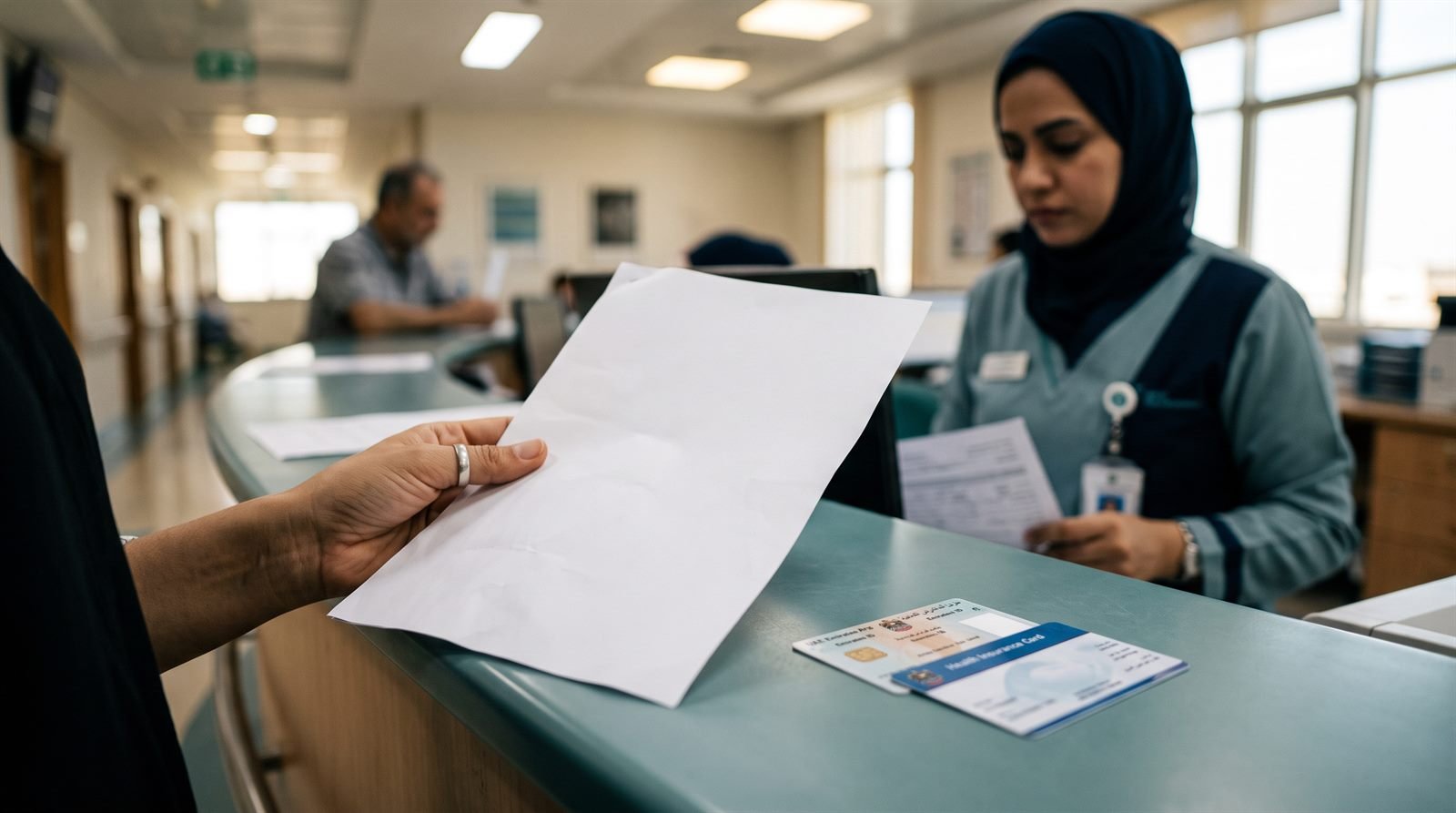
- The clinic issues a physical Referral Letter confirming you are medically stable enough to be transferred and that hospital-level care is required.
- You must physically hand this letter to the hospital’s admission desk. Without it, the hospital has no reason to treat you as an insured patient — they will register you as a “Self-Pay” walk-in, and you will be billed in full, upfront.
No referral letter means no proof your care was medically necessary in the insurer’s eyes. Keep it with your Emirates ID and insurance card, not in a bag you leave in the car.
What to Do in a Genuine Life-Threatening Situation
If what you’re facing is a true emergency — severe chest pain, heavy uncontrolled bleeding, sudden collapse, a serious accident — do not go to a clinic. Do not waste time looking for a referral. Call 998 for an ambulance, or get to the nearest government hospital, such as Rashid Hospital or Dubai Hospital, immediately. Government hospitals in Dubai are required to stabilize any patient in a genuine emergency regardless of their insurance status. Your Basic plan will cover the stabilization treatment for a true emergency — but be aware that any follow-up, non-emergency care after you’re stabilized may still need to go through the referral process above.
The “Hidden” Cost: Why Clinics Save You Money
The price gap between a clinic visit and an ER visit is enormous, and it’s the reason this whole system exists:
- Clinic consultation: typically around AED 150–300, fully covered under your outpatient benefit.
- ER consultation: typically AED 800–1,500+ as a base fee alone, before any tests, scans, or medication — and this is only covered if the visit qualifies as a true emergency.
Even in cases where the clinic ultimately refers you to a hospital, that first clinic visit is absorbed by your outpatient limit — meaning you completely avoid the hefty ER base fee that a direct walk-in would have cost you.

5 Critical Mistakes That Get Claims Rejected (Avoid These)
- Going to a hospital outside your insurer’s network because it happened to be closer.
- Getting admitted without a referral letter and pre-approval from the clinic.
- Assuming a high fever, migraine, or general “feeling terrible” automatically qualifies as an emergency.
- Showing up without your physical Emirates ID and insurance card.
- Not asking the hospital admission desk directly: “Is this admission approved by my insurer?” — before signing anything.
Frequently Asked Questions (FAQs)
Q1: If I go to the ER and it turns out not to be an emergency, will I have to pay the full bill?
Yes. In most cases, your Basic policy will deny the claim in full, and the hospital will bill you directly for the entire visit — consultation, tests, and any treatment given.
Q2: Can a clinic refuse to give me a referral letter?
Yes — and that’s actually a good sign, not a bad one. If the clinic doctor determines you don’t need hospital admission, they won’t issue a referral. Doctors are only supposed to refer patients when it’s medically necessary, which protects both you and the integrity of the system.
Q3: What if my clinic isn’t open at night, but I need help?
If it’s after hours and not life-threatening, look for a DHA-operated Urgent Care Center (such as the one in Al Barsha) — these function as an extension of the clinic network for Basic plans. You can also call your insurer’s 24-hour helpline for guidance before deciding where to go. Save that number in your phone today, before you need it at 2 AM.
Q4: Does “Basic Insurance” cover ambulance costs?
Typically, yes — but only when the ambulance is called for a genuine emergency that results in hospitalization. Don’t call an ambulance for a migraine or a sprained ankle; it won’t be treated as covered, and it takes an ambulance away from someone who may need it more urgently.
Conclusion: Be Smart, Save Your Money
Three things to remember, and keep them where you’ll actually see them again:
- True emergency? Go straight to the hospital ER, or call 998. Don’t hesitate, and don’t look for a clinic first.
- Not a true emergency? Go to a network clinic first. Every single time, no exceptions.
- Never walk into a hospital for admission without a referral letter — unless you are facing a genuine, life-threatening situation.
Have you ever faced a rejected claim in Dubai, or been caught out by this exact situation? Share your experience in the comments below — it might save someone else from the same AED 5,000 mistake.